
Millions of Americans are currently taking a drug to lose weight. Almost none of them are being asked why they gained it.
An ETT Approach to Weight Loss: Treating the Emotion Behind the Eating
According to a 2026 Gallup survey, 11 percent of American adults — roughly one in nine — are currently taking GLP-1 medications for weight loss, a figure that has more than tripled in just two years. Another 15 percent say they have taken them at some point. The drugs (Ozempic, Wegovy, Mounjaro, Zepbound) are everywhere: in the news, in celebrity culture, in waiting rooms, in medicine cabinets. They represent the most significant pharmaceutical shift in obesity treatment in a generation.
And yet, the most important question in weight loss rarely gets asked: What started this in the first place?

The GLP-1 Moment — Remarkable, But Incomplete
To be clear: for many people, GLP-1 medications work — while they are being taken. Clinical trials have shown weight losses of 15 to 20 percent of body weight, results that were once unthinkable without surgery. The enthusiasm is understandable.
But the full picture is more complicated, and for a growing number of patients, more disappointing.
The dependency is indefinite by design. GLP-1 medications work only for as long as they're taken. There is no point at which the treatment resolves the underlying pattern — the appetite suppression stops the moment the medication does, which means what starts as an intervention effectively becomes a permanent commitment, with no mechanism built in for ever addressing why the weight was gained in the first place.
The side effects are real and not trivial. A 2025 RAND survey of nearly 9,000 Americans found that about half of GLP-1 users reported experiencing nausea and roughly one-third experienced diarrhea. Beyond gastrointestinal distress, researchers have identified mixed evidence around anxiety, depression, and mood changes in some users. The FDA is actively monitoring reports of psychiatric adverse events in GLP-1 patients, including categories such as binge eating, fear of eating, and self-induced vomiting.
The eating disorder risk is underappreciated and underscreened. GLP-1 medications can trigger or worsen eating disorders — particularly in people with undiagnosed restrictive eating patterns. By suppressing appetite and rapidly accelerating weight loss, the drugs can worsen anorexia nervosa and deepen the binge-restrict cycle in binge eating disorder. The National Association of Anorexia Nervosa and Associated Disorders (ANAD) and the National Eating Disorders Association (NEDA) have both raised formal concerns that some individuals misuse GLP-1s as a tool for dangerous restriction — and that a medical community prescribing these drugs widely without adequate psychological screening places vulnerable patients at serious risk.
Even the price tag tells a complicated story.
At full retail, GLP-1s like Wegovy and Zepbound can run $1,000 to $1,640 a month — a cost that puts them out of reach for most people paying cash. Manufacturer discount programs and the arrival of a daily pill have brought that down for some, with direct-to-consumer prices now landing in the $150 to $450 range. But even that lower tier assumes ongoing access to a discount program, a subscription, or a specific pharmacy channel — not a guarantee, and not a fixed price.
Insurance complicates the picture further rather than simplifying it. When a commercial plan covers the medication for weight loss, savings cards can bring the out-of-pocket cost to as little as $25 a fill. But most employer plans still exclude GLP-1s for weight loss outright, and the ones that do cover them often require prior authorization — with no guarantee of approval. Medicare patients have more certainty for now: a temporary bridge program caps their cost at $50 a month through the end of 2027, with a permanent version expected to follow. But "for now" is doing a lot of work in that sentence. What a person pays depends on their employer, their state, their plan year, and a set of policies that keep shifting — which means that for many patients, the true cost of staying on a GLP-1 isn't just financial. It's the uncertainty of not knowing whether the price, or the coverage, will still be there next year.
Perhaps most significantly: the weight almost always comes back. Research published in eClinicalMedicine by University of Cambridge researchers found that within a year of stopping a GLP-1 medication, people regain, on average, 60 percent of the weight they lost. Another study found that 82 percent of patients who lost weight on GLP-1s regained 25 percent or more of that loss within a year of stopping. The medications function like a brake on appetite. If you take your foot off the brake, the car moves.

Surgery: Significant, But Not a Cure for the Cause
Bariatric surgery (gastric bypass, sleeve gastrectomy, adjustable banding) remains an option for those with extreme obesity, and for a specific population it produces meaningful, lasting physical results. But it carries its own substantial considerations.
It is a single, blunt instrument for a nuanced problem. Surgery reduces stomach capacity uniformly, regardless of why any given patient overeats — whether the driver is stress, trauma, boredom, or straightforward hunger. It has no mechanism for distinguishing between physical and emotional drivers of eating, and so it treats every patient as though the underlying mechanism were purely mechanical, even when it demonstrably isn't.
The risks extend well beyond the procedure itself: major abdominal surgery, an irreversible alteration of anatomy, lifelong dietary restrictions, the possibility of nutritional deficiencies, and a recovery process that is more demanding than pre-surgical consultations often fully convey.
Insurance coverage requires meeting strict criteria — typically a BMI over 40, or over 35 with documented obesity-related conditions — leaving many patients to self-pay or finance a procedure of that magnitude. Beyond cost: the risks of major abdominal surgery, an irreversible alteration of anatomy, lifelong dietary restrictions, the possibility of nutritional deficiencies, and a recovery process that is more demanding than pre-surgical consultations often fully convey.
Crucially, it shares with GLP-1s the same fundamental limitation: surgery changes what the stomach can hold. It does not change what the mind reaches for, or why. For patients whose relationship with food is driven by factors that clinical research consistently links to weight gain, including childhood adversity, chronic stress, depression, and anxiety, the behaviors find new expressions, or the weight returns over time through gradual adaptation to the new anatomy.

What Both Approaches Miss
A landmark Consumer Reports survey of 9,000 readers across 13 diet plans found something that should have shifted the entire weight loss conversation: respondents reported less success keeping weight off when their approach didn’t address the emotional triggers behind their eating. In a companion survey conducted with the American Psychological Association, 1,328 licensed psychologists were asked what they found most helpful in working with patients around weight. The consistent answer was not a diet plan. It was identifying and addressing the emotional patterns — the anxiety, the grief, the shame, the loneliness — that drive people to eat in ways that don’t serve them.
That finding sits at the center of what ETT therapists have observed for years: that for a significant number of people struggling with weight, the eating is not the problem. The eating is the solution to a problem that has never been directly treated.
Food becomes comfort when comfort feels unavailable anywhere else. Physical size can become, consciously or not, a form of protection against an environment that has felt unsafe. Avoidance of exercise is often not laziness — it is associated with possible memories (sometimes subconscious) of humiliation or trauma; or shame felt from having a body that has been criticized since childhood; or the anticipation of failure. These are emotional adaptations. And no medication, surgery, or meal plan can dissolve an emotional adaptation. Only addressing the emotion directly can do that.
Who We See — And What They Have in Common
Men and women come to this work differently. Men tend to arrive later, having endured longer, framing the issue in practical terms — energy, performance, health markers — rather than emotional ones. Women often arrive already exhausted by decades of dieting, more attuned to the emotional dimensions but worn down by a culture that has made their bodies a constant project.
Usually, clients tend to come to ETT after a version of the same experience: "I’ve tried everything."
They have tried the programs, the apps, the meal replacements, the injections, possibly the surgery. They have had success — sometimes dramatic success — and watched it reverse. Some have lost the same fifty pounds three times. Some are dealing with extreme obesity and have been told that medication or surgery is their only path. What they have in common is that they are not lazy, not weak, not lacking willpower. They are people carrying something that no diet has ever been able to take away, because no diet has had the tools to endeavor to try to.
An ETT Approach to Weight and Exercise Avoidance
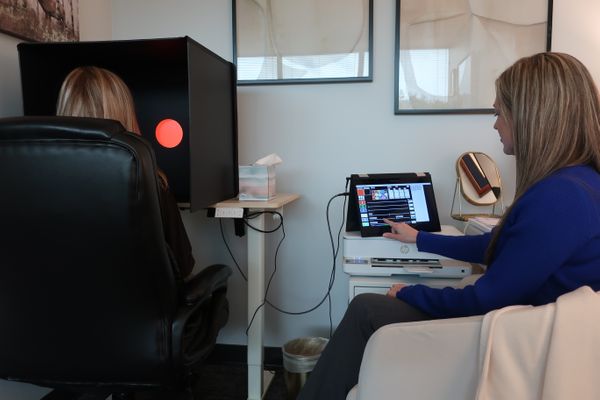
Emotional Transformation Therapy addresses these patterns at the level where they actually live — in the nervous system, in implicit emotional memory, in the neural pathways formed long before any conscious decision to overeat was ever made.
By pairing the careful exploration of the emotional experiences underlying food and body behaviors with calibrated visual and sensory stimulation, ETT creates conditions for the nervous system to process and resolve what talk therapy alone often cannot reach. Not suppress — resolve. Clients working through these patterns frequently describe a qualitative shift that feels different from anything a diet has produced: not a white-knuckled restraint of urges, but a genuine reduction in the emotional charge that was driving them. Food stops being a coping mechanism when the experience it was coping with has been worked through. Exercise stops feeling like punishment when the shame surrounding the body has begun to lift.
ETT therapists have seen this approach produce lasting results in clients who had been told that lasting results weren’t possible for them. It works not because it addresses the weight, but because it treats the source, not the symptom.
Left unaddressed, this dissonance is not benign. It is one of the underacknowledged drivers of weight returning after successful loss — the nervous system seeking to restore a familiar social equilibrium that the transformation disrupted.
ETT follow-up work helps clients integrate the full transformation: not just the physical, but the psychological and relational. Learning to inhabit a new body with confidence rather than suspicion. Building an identity that belongs to who they are now, not to who the world told them they were before.

After the Weight Loss: The Identity That Hasn’t Caught Up
There is a dimension of significant weight loss that almost no program prepares people for, and that ETT therapists consider essential to address: what happens after.
People who have lived in a larger body for years or decades have built a social identity shaped by how others have treated them. When substantial weight loss occurs, the world responds differently — sometimes warmly, sometimes in ways that are disorienting or even destabilizing. People who felt ignored previously express suddenly becoming visible. Attention that was earlier absent arrives. Romantic interest appears. And quietly, a troubling question often surfaces:
How am I supposed to respond?
We hear this described repeatedly in follow-up work: a person looking thin on the outside while still carrying, internally, the full weight of who they were before. Still moving through the world with familiar emotional habits, the wariness, the self-protective patterns of the person who was larger. Still not entirely sure how to trust the new attention, or whether they deserve it — because they know that the people now responding to them warmly might have passed them by six months ago.

A Different Question
The weight loss industry asks: How do we change the body?
Trained ETT therapists utilize methods that can access the neural pathways where emotionally-driven behaviors originate, working at the level where lasting change is actually possible.
For anyone who has expressed trying every program, every medication, every plan — and found that something keeps pulling them back — it may be worth considering that the missing piece was never a smaller size or a suppressed appetite. It was the unprocessed emotional experience that set the pattern in motion in the first place.
ETT offers a safe, non-pharmaceutical, non-surgical path toward that kind of change. One that addresses the whole person — not just the number on the scale — and has produced lasting results in clients for whom nothing else did.
The weight was never the whole story. And treating the whole story changes everything.
Ready to Take the Next Step?
If you recognize yourself or someone you love in any part of this — the exhaustion of trying everything, the weight that keeps returning, the feeling that something deeper is driving the pattern —then working with an ETT-trained therapist may be the conversation worth having.
A directory of certified ETT therapists practicing across the United States and internationally is available at etttraining.com/ett-therapist-directory. Therapists are licensed clinicians who have completed formal ETT certification training and can work with you on the emotional foundations that other approaches may never have addressed.
ETT is a complementary therapeutic approach and is not a substitute for medical care. Anyone considering changes to a weight management plan, including discontinuing medication, should consult with their qualified healthcare provider. For a list of ETT-certified providers, view our Directory.